{{ legal.summary }}
{{ sec.n }}. {{ sec.h }}
{{ p }}
Questions about this policy: legal@tancotechconsulting.com · +1 (972) 836-8111. This document is provided for the Worqex service and does not constitute legal advice to you.
{{ legal.summary }}
{{ p }}
{{ page.story.challenge }}
{{ page.story.approach }}
{{ page.story.result }}
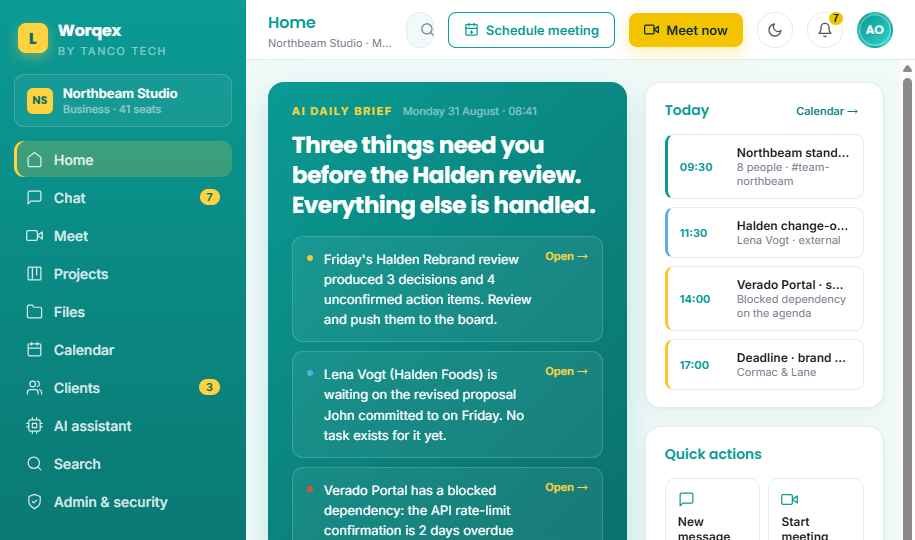
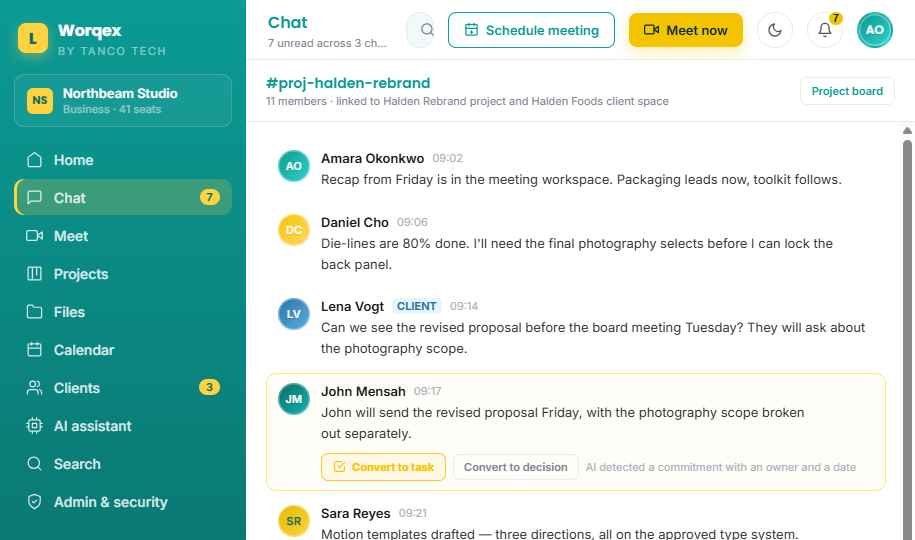
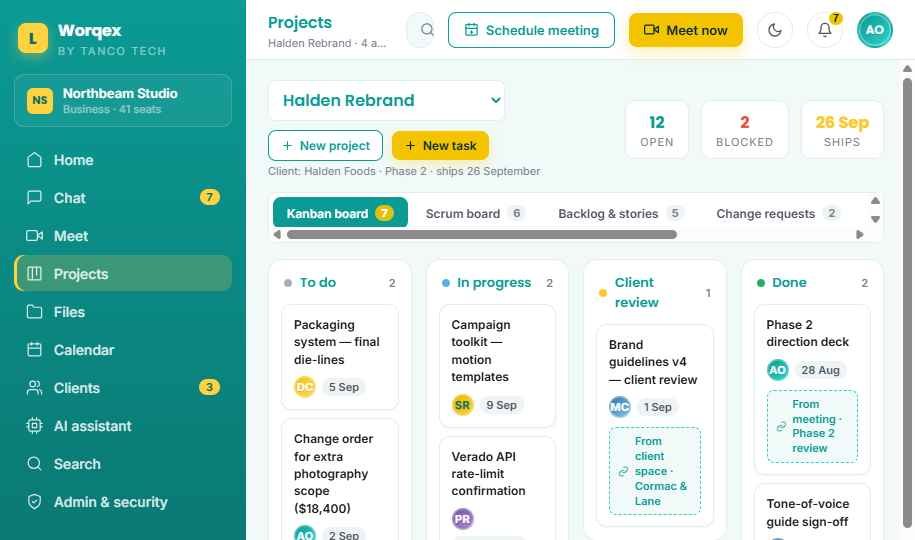
That single decision is why Worqex feels unified where legacy suites feel like modules, and why our AI can answer questions that span all of them.
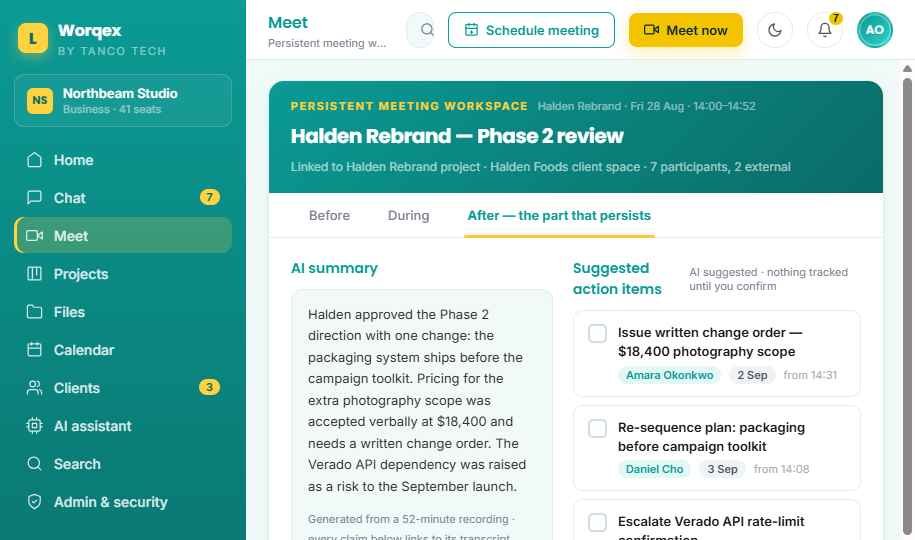
Every meeting is a persistent workspace: agenda and pre-read before, transcript and capture during, and afterwards an AI summary whose decisions and action items you confirm straight onto the board, each one linked to the second it was said.
Your data stays in US data centers you choose, meetings route through the nearest US media edge, support runs on US business hours across all four time zones, and billing is in US dollars. A client approval in Austin and a standup in Seattle live in the same object model.
Enterprise workflow suites were designed for IT departments to configure. Worqex is designed for the teams who actually talk, meet, decide and deliver, with the governance controls built in, not bolted on.
Figures from Worqex design-partner deployments; legacy-suite characteristics describe the category, not a specific vendor.
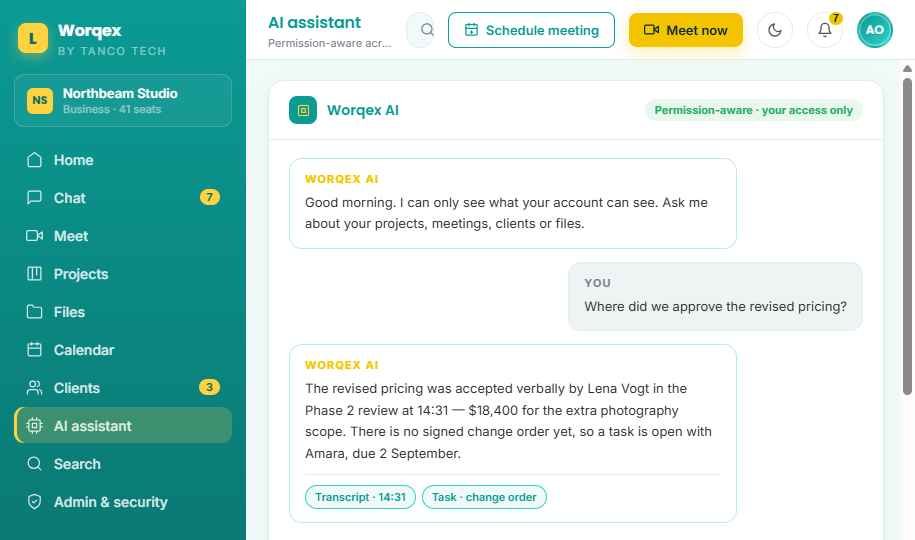
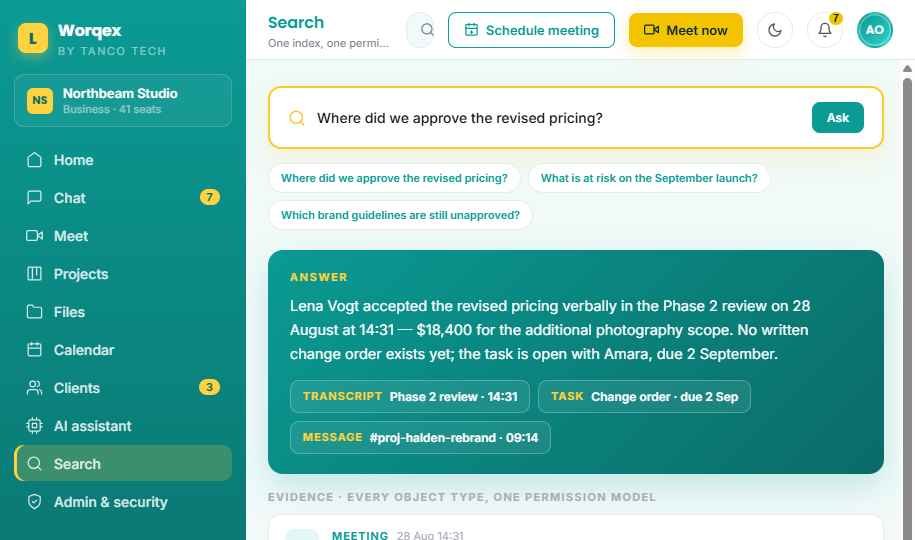
Ask "where did we approve the revised pricing?" and get the answer, the transcript second it happened, the task it created and the message that followed, filtered server-side by the same ACLs as every other screen.
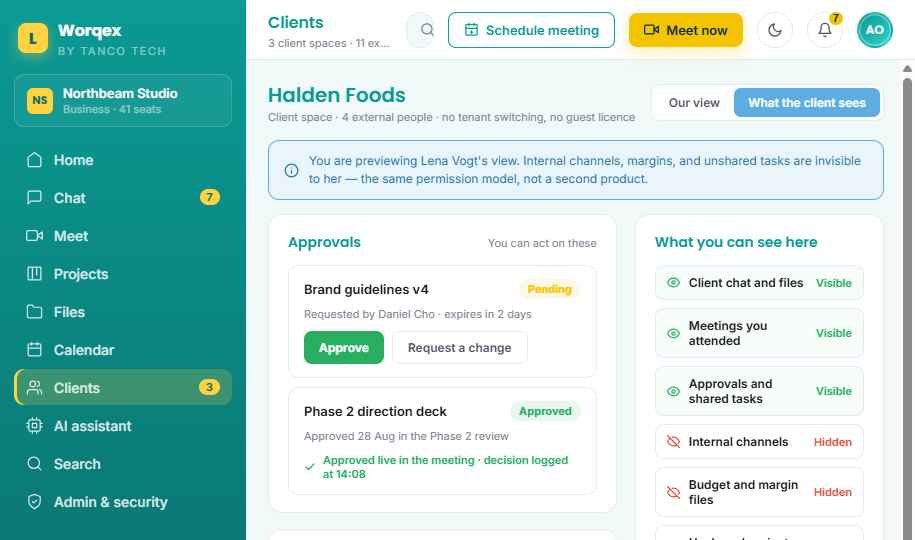
A client opens an invitation, verifies their email and lands in exactly the shared space. Internal channels, margins and unshared work are invisible by the same permission model, not a second product.
Every object carries tenant and workspace identity. Authorisation is enforced server-side, for the UI, for search and for the AI.
No implementation fee, no per-module pricing, no licence for the people you invite.